


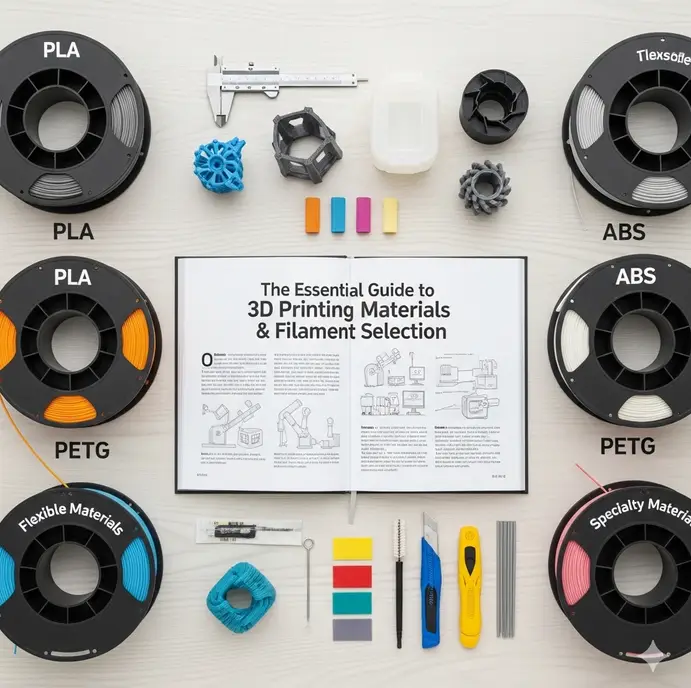
Understanding 3D Printing Material Categories
The 3D printing materials landscape can be broadly categorized into several main types, each with distinct properties and applications. Understanding these categories provides a foundation for making informed material selection decisions and helps narrow down options based on your project’s specific requirements.
Thermoplastics: The Backbone of FDM Printing
Thermoplastics form the largest category of 3D printing materials and are used primarily in Fused Deposition Modeling (FDM) printers. These materials can be heated and cooled repeatedly without significant degradation, making them ideal for both prototyping and production applications. The key advantage of thermoplastics is their versatility—they can be easily processed, modified with additives, and recycled.
Within thermoplastics, materials range from basic commodity plastics suitable for concept models to high-performance engineering polymers capable of replacing traditionally manufactured parts in demanding applications. The selection within this category alone can accommodate projects ranging from simple visual prototypes to functional parts that must withstand mechanical stress, chemical exposure, and extreme temperatures.
Photopolymers: Precision and Detail
Photopolymer resins used in SLA (Stereolithography) and DLP (Digital Light Processing) printers offer exceptional surface finish and dimensional accuracy. These materials cure when exposed to specific wavelengths of light, enabling the production of parts with fine details and smooth surfaces that are difficult to achieve with FDM printing.
The precision capabilities of photopolymer printing make it ideal for applications requiring tight tolerances, complex geometries, or excellent surface finish. However, the post-processing requirements and material handling considerations make photopolymers more suitable for specific applications rather than general-purpose use.
Specialty and Composite Materials
The frontier of 3D printing materials includes composites, ceramics, metals, and bio-compatible materials that expand the possibilities of additive manufacturing into new application areas. These materials often require specialized printing equipment and processing parameters but enable applications that were previously impossible with traditional 3D printing materials.
PLA: The Perfect Starting Point
Polylactic Acid (PLA) remains the most popular 3D printing material for good reason. Its combination of ease of use, environmental friendliness, and adequate performance for many applications makes it an excellent choice for beginners and experienced users alike. Our experience at Nuts and Boltz has shown that PLA can successfully address a surprisingly wide range of project requirements when properly applied.
Properties and Characteristics
PLA is derived from renewable resources like corn starch and sugarcane, making it biodegradable under industrial composting conditions. It prints at relatively low temperatures (190-220°C), produces minimal odor during printing, and adheres well to print beds without requiring heated chambers. These characteristics make PLA one of the safest and most user-friendly materials available.
The mechanical properties of PLA make it suitable for many prototyping applications. With a tensile strength of approximately 50 MPa and good dimensional stability, PLA parts can handle moderate mechanical loads while maintaining their shape over time. The material’s glass transition temperature of around 60°C means that PLA parts remain stable at room temperature but may soften in hot environments.
Ideal Applications
PLA excels in applications where ease of printing and good surface finish are more important than extreme mechanical performance. This includes concept models, visual prototypes, educational projects, and decorative items. The material’s ability to capture fine details makes it excellent for architectural models, artistic projects, and consumer products where appearance is paramount.
For functional prototypes that won’t be subjected to high stress or temperatures, PLA often provides an excellent balance of performance and printability. Many of our clients use PLA for initial design iterations before moving to more specialized materials for final versions.
Limitations and Considerations
The primary limitations of PLA relate to its thermal properties and long-term durability. Parts may deform in hot environments (such as car interiors in summer) and can become brittle over extended periods. The material’s relatively low impact resistance makes it unsuitable for applications involving sudden loads or impacts.
Chemical resistance is another consideration, as PLA can be affected by certain solvents and chemicals. For applications requiring chemical resistance, alternative materials should be considered.
ABS: The Versatile Workhorse
Acrylonitrile Butadiene Styrene (ABS) has been a staple of 3D printing since the technology’s early days, and for good reason. This engineering thermoplastic offers an excellent combination of strength, flexibility, and chemical resistance that makes it suitable for a wide range of functional applications. Our mechanical services team frequently recommends ABS for parts that need to perform under real-world conditions.
Superior Mechanical Properties
ABS offers significantly better impact resistance than PLA, making it ideal for parts that may experience sudden loads or impacts. With a tensile strength comparable to PLA but much better elongation at break, ABS parts can absorb energy without catastrophic failure. This toughness makes ABS the material of choice for protective housings, mechanical components, and parts that must survive drop tests.
The material’s glass transition temperature of approximately 105°C provides much better thermal stability than PLA, allowing ABS parts to function in automotive applications, outdoor environments, and other situations where elevated temperatures are encountered.
Processing Considerations
ABS requires higher printing temperatures (220-260°C) and benefits from a heated print bed and enclosed chamber to prevent warping. These requirements make ABS more challenging to print than PLA, but the improved mechanical properties often justify the additional complexity for functional parts.
Proper ventilation is essential when printing ABS, as the material can produce fumes during processing. Our facility maintains appropriate ventilation systems to ensure safe processing of ABS and other materials that require special handling.
Applications and Use Cases
ABS shines in applications requiring durability, chemical resistance, and thermal stability. Automotive components, electronic housings, mechanical parts, and consumer products all benefit from ABS’s properties. The material’s ability to be post-processed through sanding, drilling, and chemical smoothing makes it versatile for both functional and aesthetic applications.
PETG: The Best of Both Worlds
Polyethylene Terephthalate Glycol (PETG) has emerged as a popular choice that combines many of the best characteristics of both PLA and ABS while minimizing their respective drawbacks. This versatile material has become increasingly popular in our prototyping services for clients who need reliable performance without the processing challenges of more demanding materials.
Balanced Properties
PETG offers chemical resistance approaching that of ABS while maintaining the ease of printing more commonly associated with PLA. The material prints at moderate temperatures (220-250°C) and doesn’t require an enclosed chamber, making it accessible to a wide range of printing equipment.
The optical clarity of PETG when printed properly makes it useful for applications where transparency or translucency is desired. This property, combined with good chemical resistance, makes PETG popular for containers, covers, and protective barriers.
Strength and Flexibility
With tensile strength comparable to ABS but better elongation properties, PETG parts can handle significant stress while remaining flexible enough to absorb impacts. This combination makes PETG excellent for living hinges, clips, and other applications requiring repeated flexing.
The material’s layer adhesion is typically excellent, resulting in parts with consistent strength in all directions. This isotropy is important for functional parts where stress may be applied from various angles.
Processing and Applications
PETG processes easily on most FDM printers with minimal warping or adhesion issues. The material’s forgiving nature makes it an excellent choice for complex geometries that might be challenging with other materials. However, PETG can be prone to stringing and may require optimization of printing parameters for best results.
Applications for PETG include medical devices (where its biocompatibility is advantageous), food containers, protective equipment, and functional prototypes. The material’s combination of properties makes it versatile enough to serve as a general-purpose engineering plastic for many applications.
Specialty Materials: Expanding Possibilities
Beyond the traditional thermoplastics, the world of specialty 3D printing materials opens up possibilities for applications that were previously impossible with additive manufacturing. These materials often require specialized equipment and expertise but enable breakthrough applications in aerospace, medical, automotive, and other demanding industries.
Carbon Fiber Composites
Carbon fiber reinforced filaments combine a polymer matrix with carbon fiber particles or continuous fibers to create parts with exceptional strength-to-weight ratios. These materials enable the production of lightweight structural components that rival traditionally manufactured parts in performance.
The processing of carbon fiber composites requires careful attention to printing parameters and often specialized nozzles designed to handle abrasive fillers. The resulting parts exhibit excellent stiffness and strength while remaining significantly lighter than equivalent metal parts.
Metal-Filled Filaments
Metal-filled filaments contain high percentages of metal particles suspended in a polymer binder. After printing, these parts can be debinded and sintered to create dense metal parts with properties approaching those of traditionally manufactured components.
This technology enables the production of complex metal geometries that would be difficult or impossible to machine, opening new possibilities for aerospace, medical, and industrial applications.
High-Temperature Materials
Materials like PEEK, PEI, and PSU enable 3D printing of parts that can function at temperatures exceeding 200°C. These materials are essential for aerospace applications, automotive under-hood components, and industrial processes where conventional plastics would fail.
The processing requirements for high-temperature materials are demanding, often requiring specialized printers with heated chambers and precise temperature control. However, the resulting parts can replace metal components in many applications while offering weight savings and design freedom.
Material Selection Methodology
Choosing the right material for your project requires a systematic approach that considers all relevant factors and constraints. Our engineering team at Nuts and Boltz has developed a methodology that ensures optimal material selection for each unique application.
Requirements Analysis
The first step involves clearly defining the requirements your part must meet. This includes mechanical properties (strength, flexibility, impact resistance), environmental conditions (temperature, chemicals, UV exposure), aesthetic requirements (transparency, color, surface finish), and regulatory considerations (food safety, biocompatibility).
Equally important are the constraints that may limit material choices. These include budget limitations, equipment availability, timeline requirements, and post-processing capabilities. Understanding both requirements and constraints helps narrow the field of candidate materials.
Property Matching
Once requirements are defined, the next step involves matching material properties to application needs. This requires understanding not just basic properties like strength and temperature resistance, but also how these properties interact in real-world applications.
For example, a part that requires both high strength and chemical resistance might lead to different material choices than one requiring strength and transparency. Our experience helps clients navigate these trade-offs to find optimal solutions.
Testing and Validation
For critical applications, material selection should be validated through testing of printed parts under relevant conditions. This might involve mechanical testing, environmental exposure, or functional testing in the intended application.
Our portfolio of projects demonstrates the importance of validation testing in ensuring that material choices perform as expected in real-world applications.
Processing Parameters and Optimization
Successful 3D printing involves more than just choosing the right material—processing parameters must be optimized to achieve the desired properties and quality. Different materials require different approaches to temperature control, speed settings, and support strategies.
Temperature Management
Proper temperature control affects not only printability but also the final properties of printed parts. Extruder temperature, bed temperature, and chamber temperature (when applicable) must be balanced to achieve good layer adhesion while preventing degradation or warping.
Each material has an optimal temperature range, but the specific settings depend on printer design, part geometry, and desired properties. Our experience with various printer configurations helps optimize these parameters for each unique situation.
Print Speed and Quality
Print speed affects both quality and properties of finished parts. While faster printing is generally preferred for productivity, some materials and applications benefit from slower speeds that allow better layer fusion and reduced internal stress.
The relationship between speed, quality, and properties is complex and often requires experimentation to optimize for specific applications. Our team’s experience helps accelerate this optimization process.
Cost Considerations and Economic Factors
Material cost is often a significant factor in project decisions, but the lowest material cost doesn’t always result in the lowest total project cost. Understanding the full economic picture helps make informed decisions that balance performance and cost-effectiveness.
Direct Material Costs
Raw material costs vary significantly between different types of filaments and resins. Basic materials like PLA typically cost $20-30 per kilogram, while specialty materials can cost $100-500 per kilogram or more. However, material cost per part depends not only on raw material price but also on part density, infill settings, and support requirements.
Processing Efficiency
Some materials print faster or with higher success rates than others, affecting the total cost per part. A more expensive material that prints reliably may be more cost-effective than a cheaper material that requires multiple attempts or extensive post-processing.
Performance Value
The value of material selection becomes apparent when considering the performance delivered. A higher-cost material that eliminates the need for secondary operations or enables weight reduction may provide excellent value despite higher raw material costs.
Future Trends and Emerging Materials
The 3D printing materials landscape continues to evolve rapidly, with new materials and processing techniques being developed regularly. Understanding these trends helps in making strategic decisions about technology adoption and capability development.
Sustainable Materials
Environmental considerations are driving development of more sustainable 3D printing materials. This includes not only biodegradable materials but also recycled content filaments and materials designed for circular economy principles.
Smart Materials
Shape memory alloys, conductive polymers, and other smart materials are enabling new applications where printed parts can change properties in response to environmental conditions. These materials open possibilities for self-assembling structures, adaptive components, and responsive systems.
Multi-Material Printing
Advances in multi-material printing technology are enabling the production of parts with varying properties throughout their structure. This capability allows optimization of different regions of a part for specific requirements, leading to more efficient and capable designs.
Partnering for Success
Material selection and 3D printing optimization require expertise that spans materials science, mechanical engineering, and manufacturing processes. While basic applications can be handled with readily available information, complex or critical applications benefit from professional expertise and specialized equipment.
At Nuts and Boltz, our comprehensive approach to engineering services includes not only 3D printing capabilities but also the materials expertise to ensure optimal selection and processing for each application. Our experience across diverse industries and applications provides insights that can significantly improve project outcomes.
Whether you’re developing prototypes, producing small batches, or exploring new applications for additive manufacturing, our team can help navigate the complex world of 3D printing materials to find solutions that meet your specific requirements.
Conclusion: Making Informed Material Choices
The selection of 3D printing materials is both an art and a science, requiring understanding of material properties, application requirements, and processing considerations. While the abundance of available materials can seem overwhelming, a systematic approach to selection combined with expert guidance can lead to optimal choices that maximize project success.
The key to successful material selection lies in understanding that there is no single “best” material—only materials that are better or worse suited for specific applications. By clearly defining requirements, understanding material properties, and considering processing factors, you can make informed decisions that lead to successful outcomes.
As 3D printing technology continues to advance and new materials become available, the possibilities for additive manufacturing will continue to expand. Staying informed about these developments and working with experienced partners ensures that you can take advantage of new capabilities as they emerge.
Ready to explore the possibilities of advanced 3D printing materials for your next project? Contact our engineering team to discuss your specific requirements and discover how the right material selection can enhance your project’s success. Visit our facility in Sector 2, Noida, or call +91-70111-68080 to learn more about our comprehensive 3D printing and engineering services.
Looking for expert guidance on material selection for your 3D printing project? Our experienced team at Nuts and Boltz combines materials expertise with advanced printing capabilities to deliver optimal solutions.
